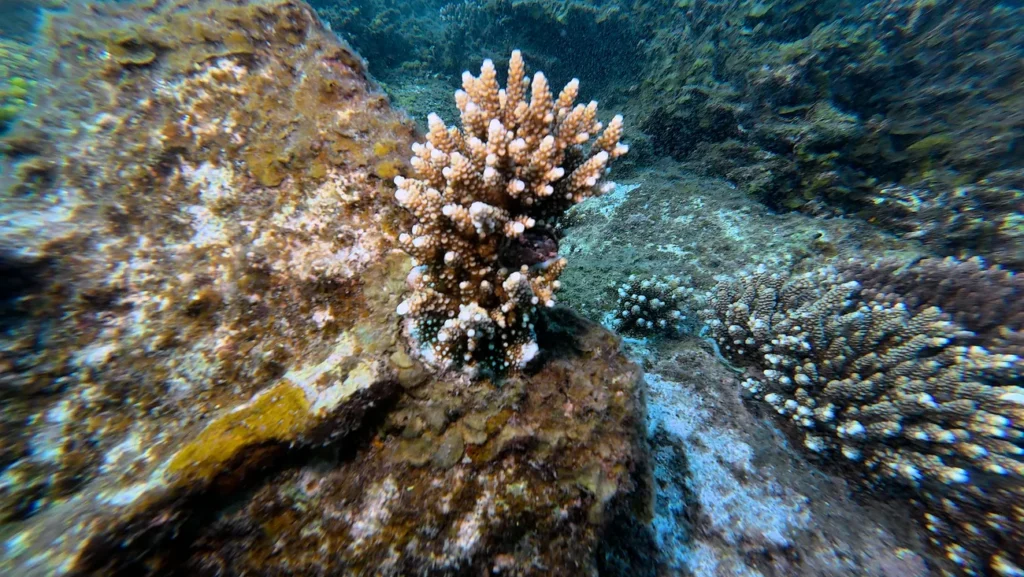
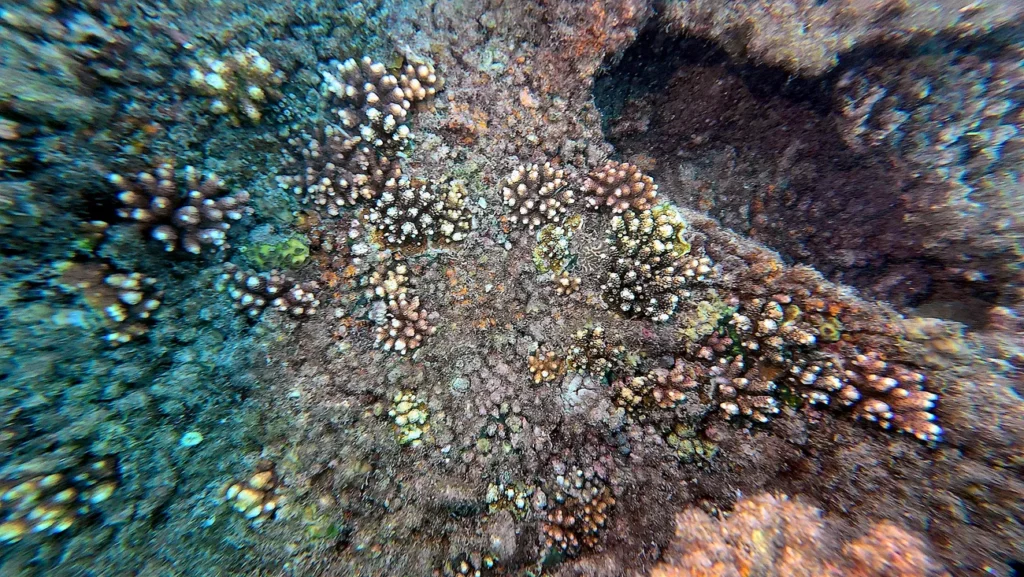
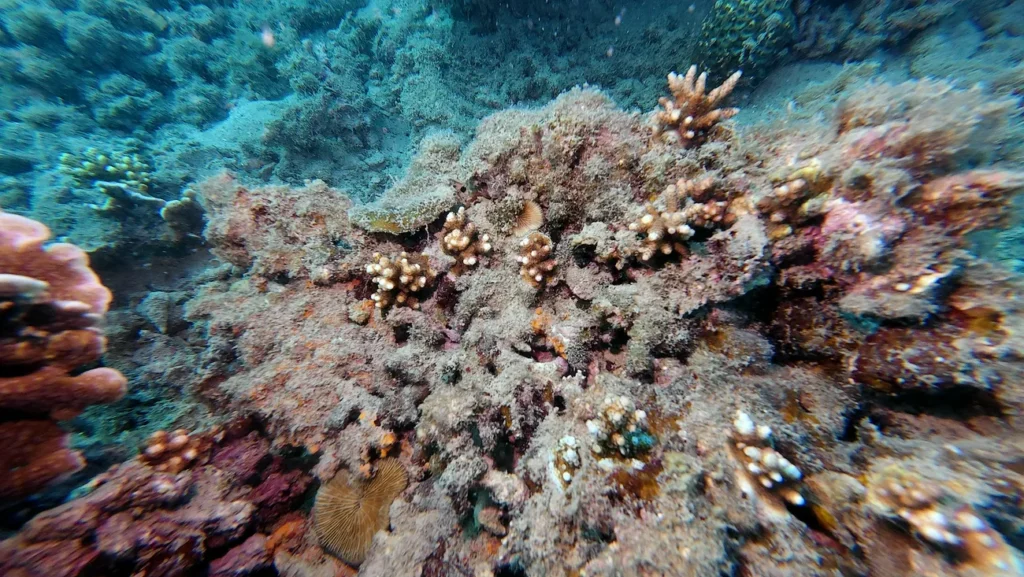
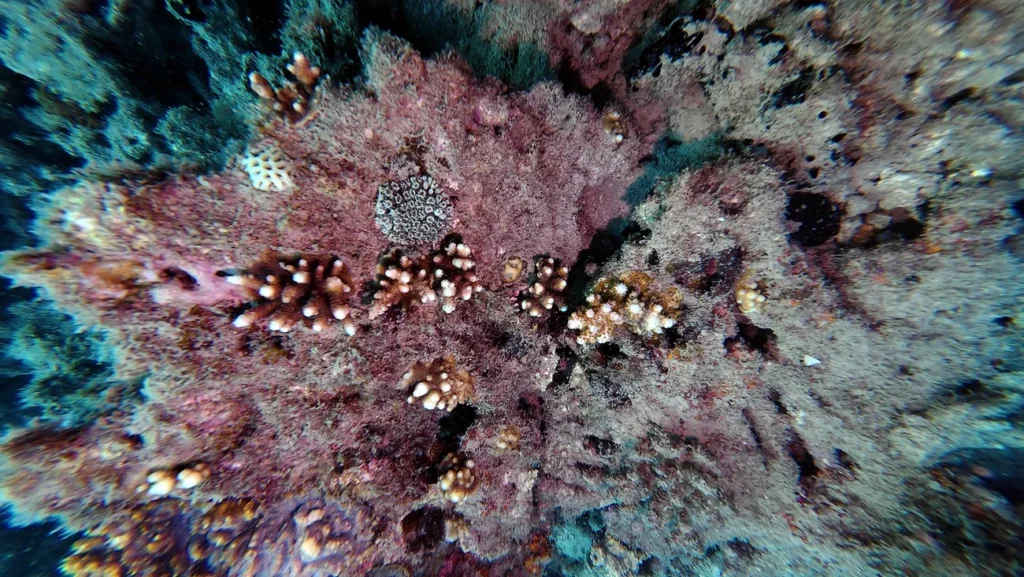
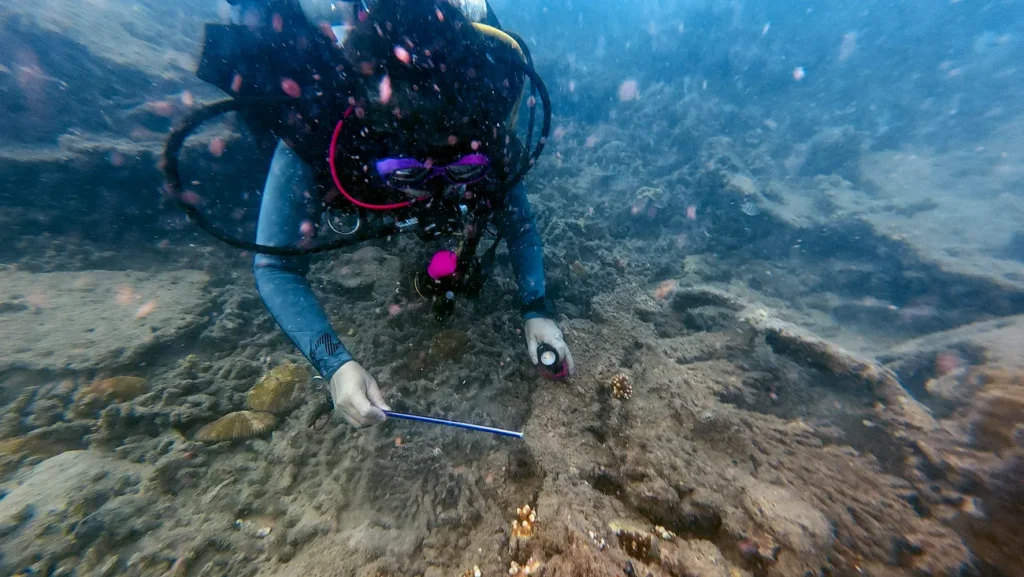
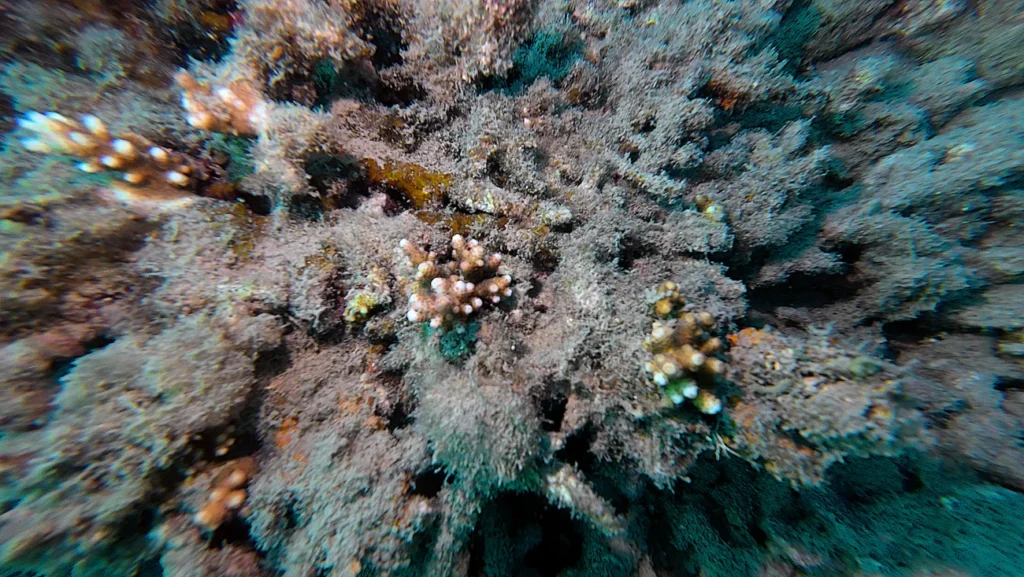
In 2026, juvenile corals are beginning to settle across damaged reef areas in Con Dao, marking the earliest stage of coral reef recovery after the 2024–2025 bleaching event.
For us, these tiny colonies are the strongest evidence that the reef has begun to rebuild itself.
What You're Seeing Here: Early Coral Reef Recovery in Con Dao
Tiny coral colonies. Scattered across a reef that still looks like it took a serious hit. No bright colours, no fish swirling around like a nature documentary. At first glance, you might think you’re looking at debris.
But for us, this changes everything.
Last year, this reef lost nearly everything. The 2024 to 2025 marine heatwave didn’t just bleach the coral; it killed most of what had been growing here for decades. We documented the full extent of that destruction in the first post of this series, Coral Reef Destruction in Con Dao. When we came back in early 2026, on our first dives at around 6–8 metres, we didn’t know what we’d find. What we found were baby corals. Holding on. Growing. Starting over.
These Aren't the Corals That Survived
This is one of the most common misunderstandings when people first see these photos.
These aren’t old corals recovering. This is what early-stage coral reef recovery actually looks like underwater. They’re a completely new generation, born after the heatwave, finding empty space on the substrate and holding on. Corals spawn once a year, usually on nights after a full moon, when millions of larvae drift through the water column and sink looking for somewhere to land. Most don’t make it. But some do.
Con Dao was lucky that enough colonies survived nearby to supply larvae. And because so much substrate had been cleared out by the heatwave, the larvae that did arrive didn’t face much competition for space. That sounds simple. It’s actually a fairly rare set of conditions to get right. If you want to understand how quickly these baby corals can grow and why they matter, that’s what we explore in the next post. This process is known as coral recruitment, and it is one of the clearest indicators of coral reef regeneration.
About That Pink-Purple Colour
A few people have asked us about the pink purple colour on the substrate in these photos. It’s not regular algae, not sediment, and not dead coral. It’s Crustose Coralline Algae (CCA), a hard calcareous algae that helps support coral reef growth and recovery.
We like seeing it. CCA means the substrate is stable and clean enough for baby corals to settle on. Coral larvae actually tend to seek out this specific surface to land on, probably because something in its chemistry signals that it’s a safe place to be. Scientists are still studying the exact chemical cues involved, but divers and researchers consistently observe the same pattern: wherever there is healthy CCA coverage, juvenile corals are usually more abundant.
Crustose coralline algae plays a critical role in coral reef recovery by providing suitable surfaces for new coral growth.
The First Time We Saw This, We Couldn't Hold It Together
This reef doesn’t look beautiful yet. No colours, not many big fish. And that’s exactly why, the first time we saw these baby corals pushing up through the damaged substrate, nobody said anything. We just floated there and looked.
We were here when this reef died. We know what it looked like a year ago. And now, on that same substrate, life is starting over. Corals are very delicate at this stage—one accidental touch, a layer of sediment, or another spike in temperature is enough to lose them. Nothing is certain. But they’re there. Alive. And growing.
How fast they can grow might actually surprise you. Con Dao reef recovery is happening. Early-stage coral reef regeneration is now visible on many of the sites we monitor. And coral reef conservation is the reason it has a chance at all.
For us, this is nothing short of a miracle.
Haven’t read the first post? Blog 1 covers what happened to Con Dao’s reef during the 2024 to 2025 marine heatwave and why it nearly lost everything. Read Blog 1: From Collapse to Comeback in our Blog section.
Frequently Asked Questions About Coral Reef Recovery in Con Dao
If you’re wondering what this means for the reef and for your dive experience, here are some of the most common questions:
1. Are there new baby corals growing at Con Dao reef?
Yes. Following the 2024 to 2025 marine heatwave, surveys have recorded significant juvenile coral settlement across bare substrate at Con Dao, particularly in areas with crustose coralline algae coverage.
2. Why are baby corals important?
Because they are the next generation of the reef. Successful coral recruitment is one of the clearest indicators that a damaged reef has begun to regenerate.
3. How long will it take Con Dao’s reef to recover?
Full structural recovery will take decades. However, the early appearance of juvenile corals just months after the heatwave is a strong sign that the regeneration process has begun.
4. Can divers accidentally damage baby corals?
Yes. Juvenile corals are extremely fragile. Good buoyancy control, avoiding contact with the reef, and choosing responsible dive operators are among the best ways divers can help protect new coral growth.
5. Does Con Dao Dive Center offer coral reef diving tours?
Yes. Con Dao Dive Center runs daily dive trips to sites where juvenile coral settlement has been documented following the 2024–2025 marine heatwave.
2026 offers a rare opportunity to witness the reef’s early recovery firsthand.
We believe the best way to protect the ocean is to help people truly see it, understand it, and respect it. Our guides dive with you not only to show you the reef, but also to explain why its recovery matters.
👉 Explore our daily dive trips: https://divecondao.com/day-trip/
Coming next in this series: Part 3 – A Reef Comes Back to Life.